GEOTECHNICALENGINEERING
RED DEER
HomeIn-Situ TestingField density test (sand cone method)

Field Density Testing – Sand Cone Method in Red Deer, AB

Sound ground. Sound decisions.

LEARN MORE

The soil profile shifts dramatically between north and south Red Deer. In Anders Park and Vanier Woods you encounter dense glacial till with silt and clay pockets; cross the river into Highland Green and you hit sandy gravel terraces over mudstone bedrock. These contrasts create compaction challenges that standard lab work cannot capture. A CBR test for road subgrades will give you a design value, but the field verification story is different. Our field density test using the sand cone method provides direct, on-site compaction measurements that reflect the actual placement conditions under your roller or plate compactor. With a population approaching 110,000 and construction spreading into areas like Timberstone and Evergreen, Red Deer demands testing that keeps pace with both residential subdivisions and commercial pad development. The sand cone test remains the reference method for verifying that lifts meet the specified Proctor density before the next layer goes down.

A single failed density test on a utility trench backfill in Red Deer can delay a paving crew by three days. The sand cone method catches under-compaction before it becomes a pavement failure.
Our service areas

Methodology and scope

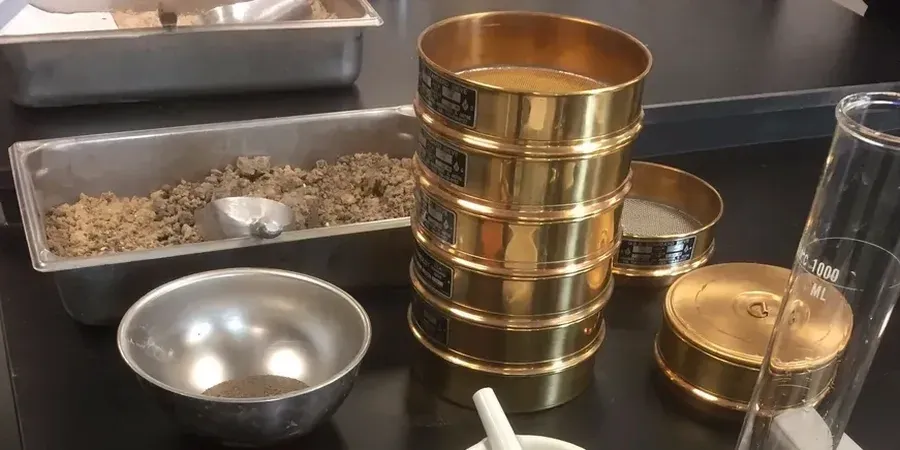
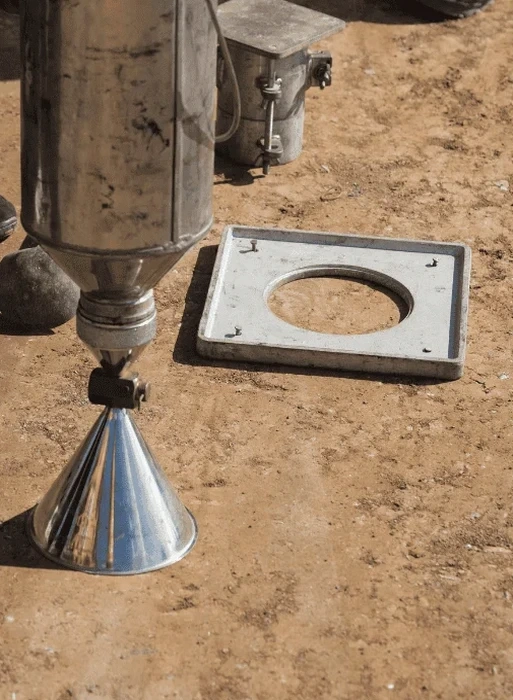
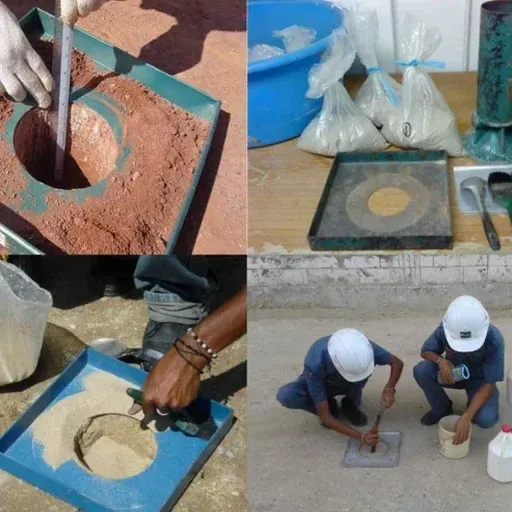
We ran tests last fall on a commercial building pad near Gasoline Alley where the contractor was placing 300 mm lifts of clay-till blend. The spec called for 98% Standard Proctor, and the first three lifts failed at 94 to 96 percent. The roller pattern needed adjustment, and the sand cone method gave us reliable numbers within twenty minutes per test. What makes this method indispensable in Red Deer is its simplicity in variable materials. The calibrated Ottawa sand flows into an excavated hole of precise diameter, and the volume displaced gives us in-place wet density. Paired with a speedy moisture test on site, we calculate dry density and compaction percentage immediately. The equipment requires no electricity, no nuclear gauge licensing, and no radiation safety officer. For deeper verification of fill beneath proposed footings, many engineers combine this test with a shallow test pit investigation to visually log the strata and confirm that the compacted zone extends to the design depth. ASTM D1556 and ASTM D698 govern the full process chain from lab compaction curve to field verification.
Field Density Testing – Sand Cone Method in Red Deer, AB
Technical reference — Red Deer

Site-specific factors

We see a recurring pattern in Red Deer subdivisions built on the glacial lake clays east of the QEII. The natural ground looks firm in dry August, but after a wet September the upper 600 mm turns plastic and rutted under truck traffic. Contractors who skip field density verification on the first structural fill lift risk trapping moisture beneath an over-compacted cap that later consolidates unevenly. Another risk zone is utility trench backfill along Gaetz Avenue and 30 Avenue corridors, where traffic vibration and freeze-thaw cycles expose poorly compacted granular backfill within two winters. The sand cone method isolates these problems lift by lift. A nuclear gauge can be faster but loses accuracy in the high-organic silts found near the Red Deer River floodplain; the sand cone gives us physical volume measurement that does not depend on soil chemistry or moisture calibration drift.

Need a geotechnical assessment?

Reply within 24h.

Email: info@geotechnicalengineering.xyz

Applicable standards

ASTM D1556 – Standard Test Method for Density and Unit Weight of Soil in Place by Sand-Cone Method, ASTM D698 – Standard Test Methods for Laboratory Compaction Characteristics of Soil Using Standard Effort, ASTM D1557 – Standard Test Methods for Laboratory Compaction Characteristics of Soil Using Modified Effort, CSA A23.1/A23.2 – Concrete Materials and Methods of Concrete Construction (referenced for subgrade prep)

Technical data

ParameterTypical value
Applicable standardASTM D1556 / ASTM D698 / ASTM D1557
Maximum particle sizeTypically 19 mm; up to 38 mm with larger cone
Test depth150 mm to 200 mm below surface
Test duration (field + calculation)15 to 25 minutes per test
Density reported as% of Standard or Modified Proctor
Sand calibrationOttawa sand (C-109) per ASTM C778
Moisture content methodSpeedy moisture tester or laboratory oven-dry
Typical compaction spec (Red Deer)95% to 98% SPD for structural fill

Frequently asked questions

What does a field density test by the sand cone method cost in Red Deer?

For projects in Red Deer and the surrounding area, a single sand cone density test typically ranges from CA$140 to CA$210 depending on the number of tests per mobilization and the travel distance. A half-day program with four to six tests offers a better unit rate than a single call-out.

How does the sand cone method compare to a nuclear density gauge on Red Deer clay-till?

The sand cone physically excavates and measures volume, so it is unaffected by the mineralogy or moisture chemistry of the local glacial till. Nuclear gauges require a moisture calibration curve that shifts in the high-plasticity silts found east of the QEII. The sand cone is slower per test but remains the referee method when nuclear gauge results are disputed.

What is the minimum number of tests required per lift on a building pad in Red Deer?

ASTM D1556 does not prescribe a fixed number; frequency follows the geotechnical engineer's specification. In Red Deer commercial projects we commonly see one test per 500 m² of pad area per lift, with a minimum of three tests per lift for pads under 1,500 m². The city may also require additional tests adjacent to foundation excavations.

Can you perform the sand cone test in freezing conditions?

Yes, with precautions. The Ottawa sand must be kept dry and free-flowing, and we shield the test area from wind-driven snow. Frozen soil near the surface must be removed to reach unfrozen material. Between November and March in Red Deer we often test on the same day the fill is placed, before overnight frost penetrates the lift.

Location and service area

We serve projects in Red Deer and surrounding areas.

View larger map