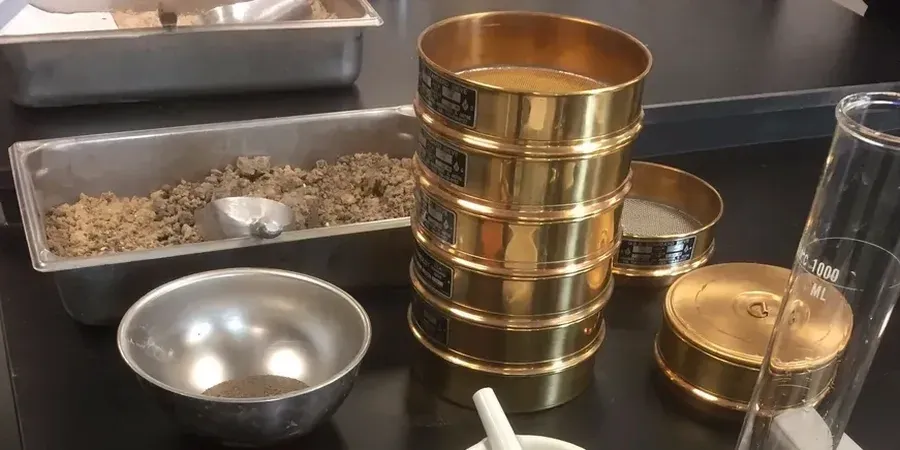
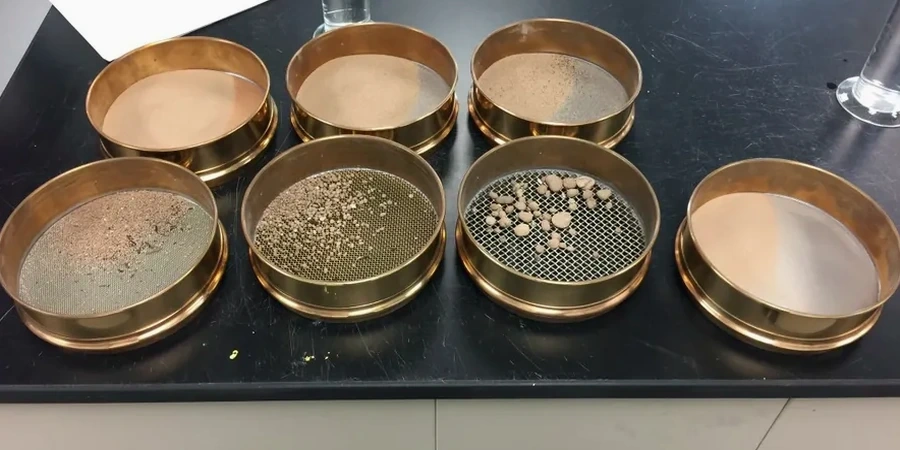
The Ro-Tap sieve shaker runs through a full nest of 8-inch brass sieves while the hydrometer cylinder settles in a temperature-controlled water bath. In our Red Deer lab, grain size analysis combines these two methods to build the full particle size distribution curve, from coarse gravel down to clay colloids smaller than 2 microns. A sample splitter divides the air-dried material before washing over the No. 200 sieve. The retained fraction goes into the mechanical shaker stack, and the fines passing through get dispersed with sodium hexametaphosphate for the sedimentation phase. Red Deer projects frequently encounter glacial till and alluvial deposits along the Red Deer River that demand this combined approach. The hydrometer readings at 15 seconds, 30 seconds, 1 minute, 2 minutes, 4 minutes, and onward capture the settlement rate of silt and clay fractions.
When the gradation curve reveals a gap-graded or poorly graded soil, we often recommend pairing the results with an Atterberg limits evaluation to determine whether the fine fraction behaves as a plastic clay or a non-plastic silt. For deeper investigation of the bearing stratum below the surficial clays, a CPT test program can map the stratigraphic continuity across the site without disturbing the sample structure.
A single hydrometer test reveals more about drainage and frost behavior in Red Deer silts than a dozen compaction curves on their own.