GEOTECHNICALENGINEERING
RED DEER
HomeFoundationsPile foundation design

Deep Foundation Design in Red Deer’s Glacial Soils

Sound ground. Sound decisions.

LEARN MORE

A mid-rise residential project along Gaetz Avenue hit refusal on dense glacial till at only nine meters. The contractor assumed shallow footings would work, but the borehole logs showed a soft clay lens directly beneath the till layer. That discovery changed the entire foundation strategy. Our lab stepped in to run consolidation and triaxial tests on undisturbed Shelby tube samples extracted from that clay seam.
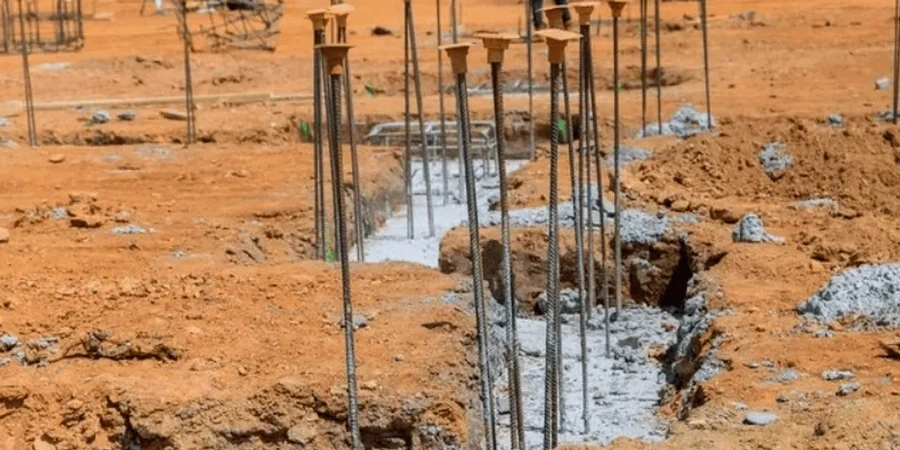
The data pushed the structural engineer toward a deep pile foundation design, socketed into the Paskapoo sandstone bedrock that underlies much of central Red Deer at depths between twelve and eighteen meters. With the Red Deer River valley cutting through the city, alluvial deposits can vary dramatically within a single block, so we always pair the field investigation with a CPT test to capture continuous soil behavior before finalizing pile lengths.

Socketing piles into the Paskapoo sandstone requires precise core recovery data: we target over 85% TCR to validate the end-bearing capacity assumptions in the design.
Our service areas

Methodology and scope

Red Deer sits at an elevation of roughly 855 meters above sea level, perched on a sequence of glacial tills, advance outwash sands, and lacustrine clays left by the last ice sheet retreat. This stratigraphy demands a pile foundation design that accounts for abrupt vertical transitions between stiff and compressible layers. We run the geotechnical characterization through a full suite of index and strength tests: Atterberg limits on clay seams, unconfined compression on till, and point-load testing on recovered sandstone cores.
Our laboratory operates under ISO 17025 accreditation, and every pile capacity calculation follows the latest NBCC and CSA A23.3 provisions. For sites near Waskasoo Creek where organic silts appear, we complement the deep foundation analysis with a grain-size analysis to quantify the fines content, which directly influences the skin friction values used in the static pile formula.
Deep Foundation Design in Red Deer’s Glacial Soils
Technical reference — Red Deer

Site-specific factors

The contrast between Riverside Meadows and Anders Park illustrates the risk clearly. Riverside Meadows, sitting on lower terraces near the Red Deer River, has thicker alluvial sands and a shallower water table. Pile foundation design there must handle potential liquefaction and higher pore pressures during spring freshet, aspects we evaluate through site-specific seismic hazard assessments. Anders Park, on the upland till plain, faces a different challenge: the stiff till can mask weathered sandstone zones that degrade rapidly when exposed to air.
If the pile toe stops just above a weathered seam, settlement can accumulate over the first freeze-thaw cycle. Our team mitigates this by requiring continuous coring into the top three meters of bedrock, verifying the rock quality designation (RQD) before signing off on the pile tip elevation.

Need a geotechnical assessment?

Reply within 24h.

Email: info@geotechnicalengineering.xyz

Applicable standards

NBCC 2020 (National Building Code of Canada), CSA A23.3:19 (Design of Concrete Structures), ASTM D1143 (Standard Test Methods for Deep Foundation Elements Under Static Axial Compressive Load), CFEM (Canadian Foundation Engineering Manual, 4th Edition)

Technical data

ParameterTypical value
Typical pile type for Red Deer tillsDriven H-piles or bored cast-in-place with rock socket
Bedrock depth (downtown core)12 to 18 meters below grade
Undrained shear strength of glacial till75 to 150 kPa (stiff to very stiff)
Paskapoo sandstone UCS range5 to 15 MPa (weak to moderately strong)
Design frost depth (NBCC)1.8 meters
Load test methodHigh-strain dynamic testing (PDA) or static load test
Seismic site class range (NBCC)Site Class C to D depending on till thickness

Frequently asked questions

How does the Red Deer soil profile affect pile foundation design?

The typical profile here involves stiff glacial till overlying the Paskapoo sandstone formation. The till itself can carry moderate loads, but the critical decision is whether to found piles in the till or socket them into the sandstone. We determine this by measuring the undrained shear strength of the till and the RQD of the sandstone core. If the till contains soft clay or silt layers, as often occurs near the river valley, a rock socket becomes the safer and more economical choice to control settlement.

What does pile foundation design cost for a typical Red Deer commercial building?

The full geotechnical investigation, laboratory testing program, and pile capacity design report for a commercial structure in Red Deer generally falls between CA$2,220 and CA$7,610, depending on the number of boreholes, the depth to competent bedrock, and whether a full-scale load test is required by the structural engineer.

Can you re-use existing pile data from a neighboring lot on our Red Deer site?

We rarely recommend relying solely on adjacent lot data. The glacial deposition in Red Deer created rapid lateral changes; a till layer present at ten meters on one property can pinch out completely thirty meters away. We can use neighboring logs to plan our investigation, but we always drill at least one new borehole on the actual building footprint and run our own laboratory index tests to confirm the stratigraphy before generating the pile design parameters.

Location and service area

We serve projects in Red Deer and surrounding areas.

View larger map