GEOTECHNICALENGINEERING
RED DEER
HomeSlopes & WallsActive/passive anchor design

Active and Passive Anchor Design in Red Deer: Ground Support Built for Alberta Conditions

Sound ground. Sound decisions.

LEARN MORE

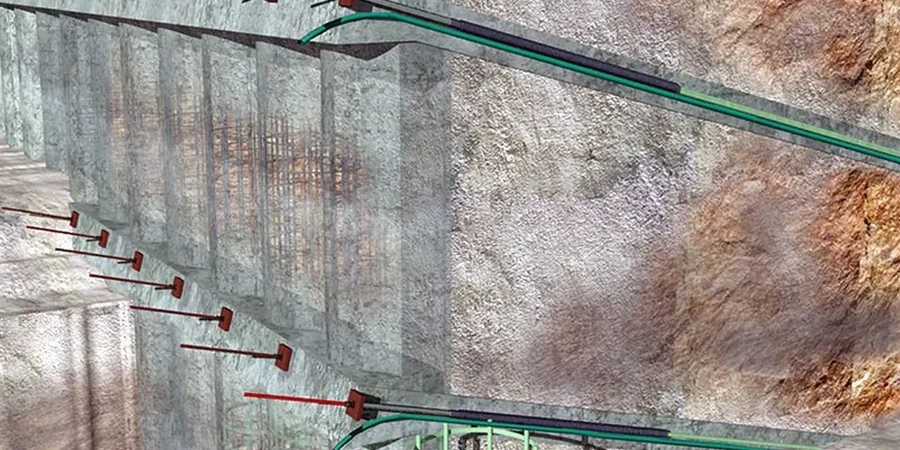
Red Deer’s growth as a service hub between Calgary and Edmonton pushed development onto the complex glacial deposits that define the Red Deer River valley. These aren’t simple soils. The advance and retreat of Pleistocene ice sheets left behind a challenging stratigraphy of till, glaciolacustrine clays, and outwash sands. When excavations exceed four meters in downtown Red Deer, passive resistance from a buried deadman block often isn’t enough. That’s where active anchors come into play. A well-designed active/passive anchor system transfers tensile loads deep into competent till, bypassing the near-surface weathered zone that has caused problems for so many projects near Waskasoo Creek. Our design approach integrates data from a sondaje SPT to verify refusal depth and confirms the grout-to-ground bond strength before a single strand is tensioned.

In Red Deer’s glacial till, anchor capacity is governed by the weakest clay seam within the bond zone, not the average strength of the entire stratum.
Our service areas

Methodology and scope

The most common error we see in the Red Deer market is assuming a uniform bond stress along the entire anchor bond length without testing. Contractors will sometimes propose a 12-meter bond zone in a soil profile that includes a slick, high-plasticity clay seam at meter eight. That seam controls the entire anchor’s capacity. The upper and lower portions contribute almost nothing once the interface starts creeping. We design with progressive debonding in mind. Anchor capacity depends on the weakest stratum within the bond zone, not the average. Our load-transfer models break the bond length into discrete segments and apply strain compatibility. We specify strand type, eccentricity, and lock-off load based on the real stratigraphy logged from test pits or continuous flight auger cuttings. Every anchor gets a unique design sheet, not a copy-paste template from a Calgary job. Red Deer’s till is stiffer and drier than what crews encounter further south, and the design should reflect that.
Active and Passive Anchor Design in Red Deer: Ground Support Built for Alberta Conditions
Technical reference — Red Deer

Site-specific factors

A five-story mixed-use building on Gaetz Avenue required a 7-meter-deep excavation adjacent to a 1960s-era masonry structure with no engineered foundation. The original shoring design called for three rows of passive tiebacks socketed into the glacial till. During installation, the drilling subcontractor hit a pocket of saturated outwash sand at 4.5 meters depth. The passive anchors lost bond immediately. Water migration through the sand lens began eroding the excavation face, and the adjacent building started showing fresh step-cracking in the brick veneer. We redesigned the support system overnight. The lower two rows were converted to active post-tensioned anchors with a regroutable sleeve system. The upper row was replaced with a continuous reinforced shotcrete beam. The active anchors were stressed to 400 kN each within 48 hours, and building movement stopped. The lesson is clear. Red Deer’s river-valley geology does not forgive assumptions about pore pressure or soil homogeneity. Active anchor design gives you the control that passive systems cannot when conditions change suddenly.

Need a geotechnical assessment?

Reply within 24h.

Email: info@geotechnicalengineering.xyz

Applicable standards

CSA A23.3-14 Annex F: Design of Post-Tensioned Anchorages, CFEM 2006 (Canadian Foundation Engineering Manual, 4th Ed.), NBCC 2020 Section 4.2: Structural Design — Earth and Water Pressure, PTI DC35.1-14: Recommendations for Prestressed Rock and Soil Anchors

Technical data

ParameterTypical value
Design standard for post-tensioned anchorsCSA A23.3 Annex F, PTI DC35.1-14
Typical anchor capacity range (alluvial soils)200 to 1,200 kN per strand group
Bond length verification methodIn-hole SPT-N60 and pocket penetrometer on continuous samples
Minimum free length behind failure planeGreater of 4.5 m or H/5 (per CFEM 2006)
Lock-off load specification100% to 110% of design working load, with lift-off testing
Corrosion protection grade for permanent anchorsClass II double-corrugated HDPE sheathing with factory-grouted strand
Proof loading acceptance criteriaCreep rate < 2.0 mm per log cycle at 1.33x working load

Frequently asked questions

What is the difference between active and passive anchors for a retaining wall in Red Deer?

A passive anchor develops its force through movement. The soil has to displace enough for the anchor to mobilize resistance, which means the wall will deflect before the anchor engages. An active anchor is post-tensioned with a hydraulic jack after grouting. You apply the design load immediately, and the wall moves very little. In Red Deer’s stiff glacial till, passive systems can work for low walls with moderate surcharge. But when you are protecting an existing structure or excavating deeper than five meters, active anchors give you control over wall deflection from day one. The downside is a more involved installation and testing procedure.

How much does anchor design and testing cost for a typical Red Deer project?

A complete anchor design package for a modest shoring project in Red Deer, including site-specific calculations, installation specifications, and on-site proof testing supervision, generally falls between CA$1.500 and CA$4.470. The range depends on the number of anchor rows, whether corrosion protection is Class I or II, and how many proof tests are required per the acceptance criteria in CSA A23.3.

What soil investigation is needed before designing anchors in the Red Deer area?

You need more than a basic borehole log. We require SPT-N60 values at 1.5-meter intervals within the proposed bond zone, Atterberg limits on fine-grained layers, and a clear identification of any sand or silt seams that could cause grout loss or water migration. If the site is near the Red Deer River escarpment, we also recommend a groundwater monitoring standpipe installed for at least 72 hours before finalizing the free-length design. Undetected perched water has caused more anchor failures in this city than any other single factor.

Location and service area

We serve projects in Red Deer and surrounding areas. More info.

View larger map