GEOTECHNICALENGINEERING
RED DEER
HomeGeophysicsElectrical resistivity / VES (Vertical Electrical Sounding)

Electrical Resistivity Testing & VES Surveys in Red Deer

Sound ground. Sound decisions.

LEARN MORE

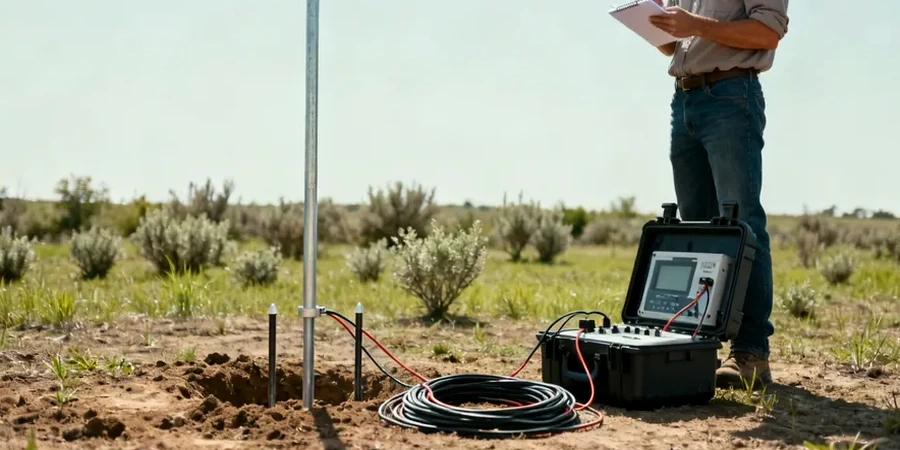
Red Deer sits at roughly 860 meters elevation, right in the middle of the Calgary-Edmonton corridor where the Quaternary sediments can top 100 meters thick. That depth of glacial drift, till, and buried valley fill creates real questions about what lies beneath a site before earthworks or foundation design begins. We run electrical resistivity and vertical electrical sounding surveys to map those subsurface layers without putting a trackhoe on the ground on day one. The method measures how easily current passes through soil and rock—clay conducts, dry gravel resists, and the contrast tells the story. For projects along the Red Deer River or out toward Gasoline Alley, where stratigraphy shifts fast over short distances, a well-planned resistivity line often catches a buried channel or a perched water table that conventional drilling might miss between boreholes. We combine the resistivity data with test pit observations when shallow validation is needed, or integrate it with seismic refraction profiles to cross-check bedrock depth interpretations.

In the Red Deer River valley, resistivity contrasts between dry terrace gravels and saturated silt can exceed 10:1—mapping that boundary accurately is what prevents dewatering surprises mid-excavation.
Our service areas

Methodology and scope

The surficial geology around Red Deer is dominated by glacial till, glaciofluvial sands, and glaciolacustrine silts draped over the Paskapoo Formation bedrock. What complicates resistivity interpretation here is the seasonal saturation of the upper till—spring melt drives resistivities down, while late-summer drying pushes them up, and failing to account for that shift can skew layer models by several meters. We run Schlumberger and dipole-dipole arrays depending on whether the target is vertical resolution for aggregate thickness or lateral continuity for contaminant plume tracking. Every sounding is calibrated against available well logs from the Alberta Water Well Information Database and tied to the lithology we encounter in auger holes or split-spoon samples. On brownfield sites along the north end industrial corridor, resistivity imaging helps delineate hydrocarbon-impacted zones because the degraded product often shows a distinct low-resistivity signature against clean coarse-grained soils. That kind of contrast mapping feeds directly into remediation scoping and excavation planning without disturbing subsurface conditions during the investigation phase.
Electrical Resistivity Testing & VES Surveys in Red Deer
Technical reference — Red Deer

Site-specific factors

NBCC 2020 requires that subsurface investigations characterize soil and groundwater conditions to a depth adequate for the proposed structure—and in Red Deer, the buried preglacial valleys cutting into the Paskapoo Formation create exactly the kind of hidden geometry that can violate that requirement if only discrete boreholes are used. A resistivity line that misses a 15-meter-deep silt-filled channel between two boreholes spaced 50 meters apart produces a clean bill of health for a site that actually requires deep foundations or ground improvement. We have seen this scenario play out on the east side of the city where the modern river has reworked older valley fills, leaving soft lenses directly beneath competent-looking surface till. The consequence of undetected variability is differential settlement that shows up within the first two freeze-thaw cycles. Pairing resistivity coverage with targeted CPT soundings gives us the continuous conductivity profile plus the mechanical tip resistance and sleeve friction—two independent datasets that either agree or force us to revisit the interpretation before the structural engineer commits to a foundation type.

Need a geotechnical assessment?

Reply within 24h.

Email: info@geotechnicalengineering.xyz

Applicable standards

NBCC 2020 (National Building Code of Canada), CSA A23.3 (Design of Concrete Structures), ASTM D6431 (Standard Guide for Using the Direct Current Resistivity Method for Subsurface Investigation)

Technical data

ParameterTypical value
Array configurationsSchlumberger, Wenner, dipole-dipole, pole-dipole
Typical investigation depth5 m to 120 m (depending on array and geology)
Measurement range0.1 ohm-m to 1,000,000 ohm-m
Data acquisition systemMulti-electrode resistivity meter with automatic switching
Inversion softwareRes2DInv / Res1D, smoothness-constrained least-squares
Calibration referenceAlberta Water Well Information Database lithology logs
Reporting standardNBCC 2020 subsurface investigation requirements
Depth of investigation factorAB/2 ranging from 1.5 m to 300 m for VES soundings

Frequently asked questions

What does an electrical resistivity survey in Red Deer cost?

For a typical site investigation in the Red Deer area, electrical resistivity surveys and VES soundings run between CA$840 and CA$1,580 depending on the line length, number of soundings, array configuration, and whether 2D tomography or 1D profiling is required. Projects requiring deeper penetration or multiple intersecting lines will fall toward the upper end.

How deep can a VES survey investigate in the Red Deer glacial deposits?

With a Schlumberger array expanding to AB/2 spacings of 300 meters, we can reach investigation depths of approximately 100 to 120 meters in the glacial drift and Paskapoo bedrock typical of the Red Deer area. The actual depth of investigation is controlled by the maximum current electrode separation, the subsurface resistivity contrast, and the background noise level at the site.

How do seasonal groundwater changes affect resistivity readings in central Alberta?

Surface saturation from spring snowmelt can depress apparent resistivities in the upper 3 to 5 meters of till by 30 to 50 percent compared to late-summer dry conditions. We account for this by recording soil moisture conditions at the time of the survey and, where possible, scheduling repeat soundings during different seasons to bracket the range of natural variability before interpreting layer models.

Can resistivity distinguish between clay till and silt in the Red Deer River valley?

It can, but the overlap requires calibration. Both clay-rich till and saturated silt produce low resistivities, typically in the 10 to 40 ohm-m range. We differentiate them by tying the resistivity model to borehole logs, Atterberg limits, and grain-size data from nearby wells. Without that lithological ground truth, a low-resistivity layer can only be reported as a fine-grained unit, not specifically identified as till versus glaciolacustrine silt.

Location and service area

We serve projects in Red Deer and surrounding areas.

View larger map