GEOTECHNICALENGINEERING
RED DEER
HomeLaboratoryLaboratory CBR test

Laboratory CBR Test in Red Deer: Subgrade Strength for Pavement Design

Sound ground. Sound decisions.

LEARN MORE

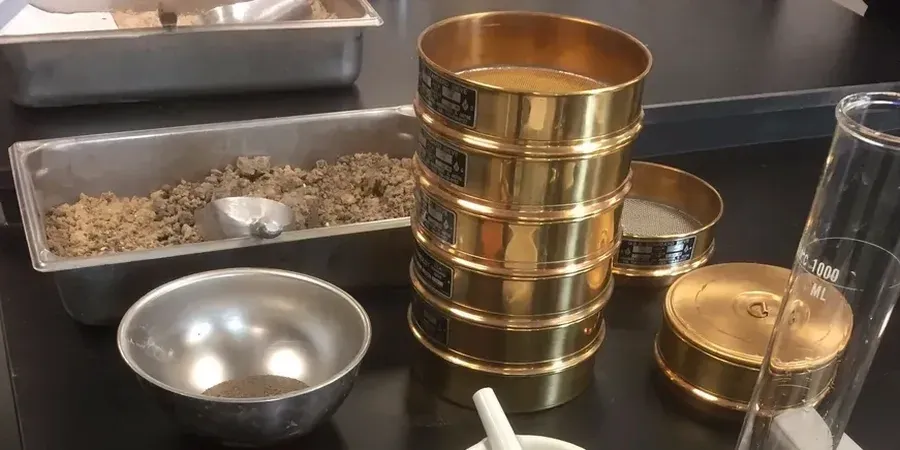
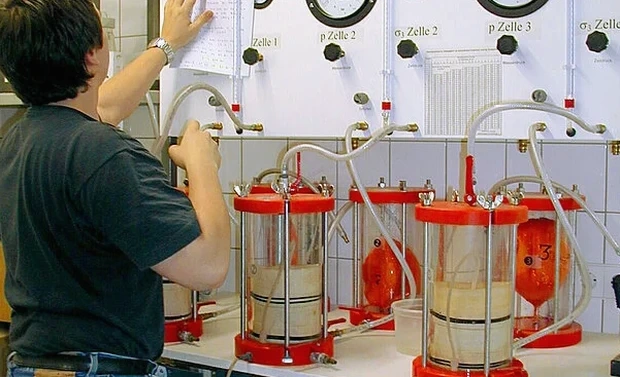
The loading press sits inside a temperature-controlled chamber. A cylindrical plunger descends at a steady 1.27 mm per minute, pushing into a compacted soil specimen. That is the laboratory CBR test in motion. Technicians in Red Deer rely on this setup to measure how much pressure a subgrade or base material can take before it deforms. The reading comes from a calibrated proving ring and a dial gauge tracking penetration. Every data point feeds directly into pavement thickness calculations. For a city that handles freeze-thaw cycles and heavy truck traffic along the QEII corridor, knowing the soaked CBR value is not optional. It determines whether a parking lot survives its first spring or turns into a maintenance headache. Before a single grader moves on site, the grain-size analysis and the compaction curve are already on the bench, setting the stage for the CBR specimen preparation.

A soaked CBR below 3 percent in Red Deer's glaciolacustrine clays means pavement failure is not a question of if, but when.
Our service areas

Methodology and scope

Red Deer sits in a glacial spillway carved by meltwater from the retreating Laurentide ice sheet. The surficial geology across the city shifts from coarse outwash gravels on the higher benches to glaciolacustrine silts and clays in the lower flats near the Red Deer River. This variability shows up directly in the CBR values we measure. A well-graded gravel from a pit east of Gasoline Alley might yield a soaked CBR above 80 percent. A lean clay from a site in the Riverside Meadows area often drops below 3 percent in saturated condition. That gap is enormous. It means the same asphalt section that works flawlessly on gravel will rut and crack on clay within two seasons. The laboratory procedure follows ASTM D1883, with specimens compacted at optimum moisture content using modified Proctor energy. We soak the samples for 96 hours to simulate the worst groundwater conditions that central Alberta roads face during spring thaw. When the results come back low, the design team typically evaluates soil improvement options. In many Red Deer projects, we combine the CBR data with a plate-load-test to validate in-situ stiffness before placing the structural fill.
Laboratory CBR Test in Red Deer: Subgrade Strength for Pavement Design
Technical reference — Red Deer

Site-specific factors

A warehouse expansion broke ground in late September north of Edgar Industrial Park. The geotechnical report flagged silty clay with sand lenses. The owner decided to skip the laboratory CBR suite and relied on a visual classification alone. Asphalt went down in October. By mid-April the following year, the truck loading bay showed alligator cracking and depressions exceeding 40 millimeters. Core samples confirmed the base course had mixed with the subgrade during spring thaw. The repair cost ran five times what the original testing program would have. Red Deer's freeze-thaw cycles penetrate deep into the subgrade, and the soaked CBR value is the only reliable predictor of how a pavement structure will behave under those conditions. Even a well-compacted granular base cannot compensate for a subgrade that loses bearing capacity when saturated. The laboratory test removes the guesswork. It gives the pavement designer a number they can plug directly into the AASHTO 1993 design equation or the mechanistic-empirical models used by Alberta Transportation.

Need a geotechnical assessment?

Reply within 24h.

Email: info@geotechnicalengineering.xyz

Applicable standards

ASTM D1883 – Standard Test Method for California Bearing Ratio (CBR) of Laboratory-Compacted Soils, ASTM D1557 – Standard Test Methods for Laboratory Compaction Characteristics of Soil Using Modified Effort, Alberta Transportation Pavement Design Manual, NBCC 2020 – National Building Code of Canada

Technical data

ParameterTypical value
Standard followedASTM D1883
Compactive effortModified Proctor (56,000 ft-lbf/ft³)
Soaking period96 hours minimum
Penetration rate1.27 mm/min (0.05 in/min)
Surcharge weight4.5 kg annular weights minimum
Specimen diameter152.4 mm (6 in) standard mold
Reported CBR valuesAt 2.5 mm and 5.0 mm penetration

Frequently asked questions

What does a CBR test cost in Red Deer?

A standard laboratory CBR test on a single specimen, including compaction and 96-hour soaking, typically ranges from CA$160 to CA$330 depending on the number of points required and whether companion classification tests like grain size and Atterberg limits are included. A full pavement investigation suite with multiple CBR points, Proctor curves, and chemical analysis runs higher and we provide a tailored quote after reviewing the site conditions and project scope.

How long does the laboratory CBR test take?

The full procedure requires a minimum of five working days. The soil must be dried, processed, and compacted into molds. The specimens then soak for 96 hours under water to simulate saturated subgrade conditions. After soaking, the penetration test runs and data reduction follows. Expedited turnaround is possible if the compaction curve is already established and fewer soaking days are acceptable, but for design-grade results in Red Deer's moisture-sensitive clays, the full soaking period is essential.

What is the difference between field CBR and laboratory CBR?

Field CBR tests measure the in-situ strength of the subgrade at its natural moisture content and density, using a reaction frame and a penetration piston on the exposed soil surface. Laboratory CBR tests compact the soil to a specified density and moisture condition, then soak the specimen before testing. The laboratory value is almost always lower for fine-grained soils because the soaking simulates the worst-case saturated condition. Pavement design in Red Deer uses the soaked laboratory CBR as the conservative input to account for spring thaw conditions.

Which soils in Red Deer need CBR testing?

Any soil that will support a pavement, parking lot, or floor slab benefits from CBR testing. In Red Deer, the glaciolacustrine silts and clays found in the lower areas near the river are particularly critical because their soaked CBR can drop below 3 percent. Even the gravelly outwash deposits on the benches should be tested to confirm they meet the minimum 20 to 30 percent CBR typically specified for sub-base materials in commercial developments.

Location and service area

We serve projects in Red Deer and surrounding areas.

View larger map